Neonates and children are frequently transfused patient populations, yet they are relatively under-represented in clinical trials, and the evidence base to guide practice is limited. Several clinical practices are extrapolated from the results of adult studies. Yet neonates and children have unique pathophysiology, specific vulnerabilities and different risk profiles compared to adult transfusion recipients.
Substantial variability in practice exists in clinical transfusion, patient blood management and blood conservation in paediatrics and a disproportionate number of transfusion adverse events are reported in the neonatal and paediatric age groups. Neonatal and pediatric patients are the longest surviving recipients of transfusion. Transfusion decision-making in paediatrics needs to consider the potential risks and benefits of a transfusion and any alternatives to transfusion.
About us
The Pediatric Transfusion Subgroup functions under the Clinical Transfusion Working Party of the International Society of Blood Transfusion (ISBT). Our mission is to advance safe, evidence-based, and equitable transfusion practices for neonates, infants, children, and adolescents worldwide.
Pediatric patients are not “small adults.” They have unique physiological characteristics, transfusion thresholds, immunohematologic considerations, and vulnerability to both under- and over-transfusion. This subgroup aims to address these distinct challenges through collaboration, research, education, and global advocacy.
The group aims to
- Develop and disseminate evidence-based guidance in pediatric transfusion
- Foster international research collaborations
- Identify knowledge gaps and prioritize multicenter studies
- Promote pediatric-specific hemovigilance initiatives
- Support capacity building in low- and middle-income countries
- Engage multidisciplinary stakeholders in advancing pediatric transfusion care
Why pediatric transfusion needs dedicated focus
- Limited high-quality randomized trials in children
- Significant global variation in practice
- Underrepresentation in hemovigilance datasets
- Unique transfusion risks in neonates and critically ill children
- Increasing complexity of pediatric oncology, transplant, and critical care
- Addressing these challenges requires coordinated global efforts and multidisciplinary collaboration.
Leadership
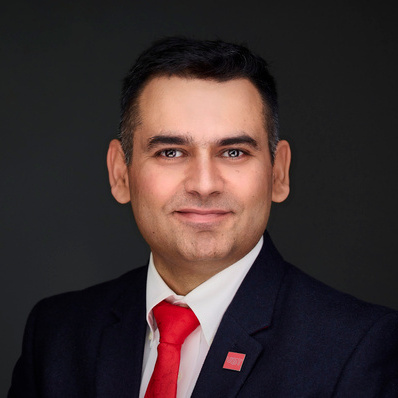
Satyam Arora
ISBT Regional Director South East Asia, Additional Professor, Transfusion Medicine, Post Graduate Institute of Child Health (PGICH), Noida, India
Dr Satyam Arora, MBBS, MD (Transfusion Medicine), CABP (AABB) completed his MD in 2012 from the prestigious Post Graduate Institute Medical Education and Research (PGIMER), Chandigarh, India. He established a pediatric transfusion-focused academic transfusion medicine department at a stand-alone children’s hospital (under the Government) in India and currently working there as an additional professor. He is presently working to establish a dedicated pediatric hematopoietic stem cell transplant and cell therapy centre at the same institute.
He has done various international rotations (observerships) in hematopoietic stem cell transplants (Cleveland Clinic, USA) and Cell Therapy (Centre for Cell and Gene Therapy, Baylor Medical Center, USA). He is a member of the Technical Resource Group (TRG) on blood transfusion services (BTS) under the Directorate General Health Services under the Government of India and an expert member of India's National Donor Vigilance Program. He has been a member of ISBT since 2012 and was a founder member, past chairperson and South-East Asia representative with the Young Professional Council (YPC) of ISBT. Presently he is secretary of the Clinical Transfusion Working Party, co-chair of the Pediatric Transfusions subgroup of ISBT and member of the Hemovigilance Working Party. He is the recipient of many prestigious awards such as “Dr Harold Gunson” Fellowship (2012), the ISBT TTID Working Party Travel Award for Young Scientists (2014), “Young Scientist Award” by the Indian Society of Transfusion Medicine 2021and “Narendra S Bagaria Award” by the Indian Society of Blood Transfusion and Immunohematology (2022). His areas of interest are pediatric transfusions, hematopoietic stem cell transplants, apheresis science and hemovigilance.
Do you have a question for Satyam? Fill in the form below.
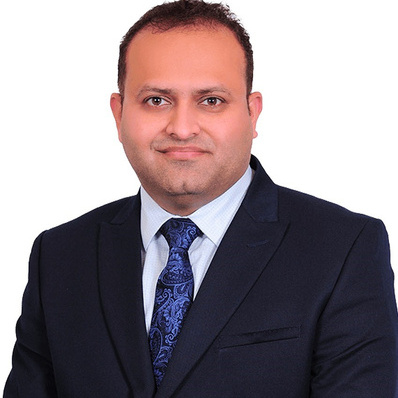
Ravi C Dara
Dr. Ravi Dara, MD, MBBS, is a Specialist Physician in Transfusion Medicine in the Department of Transfusion Medicine and Laboratory Medicine Services at Sheikh Shakhbout Medical City (SSMC) in Abu Dhabi.
Dr. Dara has more than 8 years of experience practicing as a consultant and a Transfusion Medicine Physician. Dr. Dara has received the Harold Gunson Fellowship Award twice because of his contribution to academia. He has more than 30 research papers published in academic journals. Dr. Dara has also been extensively trained in therapeutic apheresis, immunohaematology, and cellular therapy. Dr. Dara gained his medical degree from Panjabrao Deshmukh College in Maharashtra, India before pursuing a doctorate in medicine in Transfusion Medicine from the Post Graduate Institute of Medical Education & Research (PGIMER). He started his professional journey in India, working as an attending consultant at the Medanta – The Medicity Hospital and serving, later on, as the Head of Transfusion Medicine at Manipal Hospital before moving to the UAE and joining SSMC.
Current Initiatives
- Global surveys on pediatric transfusion practices
- Collaborative research on pediatric massive transfusion
- Development of pediatric transfusion educational modules
- Engagement with hemovigilance working parties for pediatric data harmonization
- Joint initiatives with other ISBT working parties and external societies
- Umbilical Cord Blood Transfusion
Resources
Find below a selection of the most recent resources on Paediatric Transfusion. To see the full resources library of this subgroup, please go to the Resources page of the Clinical Transfusion Working Party and use the search option: Topic - Paediatric Transfusion.
Collaborative work published by the subgroup (recent)
- Arora S, Dua S, Goel R. Neonatal and pediatric transfusion practices and policies in India: A survey-based cross-sectional assessment of blood centers. Transfusion. 2022 May;62(5):1000-1009. doi: 10.1111/trf.16857. Epub 2022 Mar 31. PMID: 35357016.
- Al-Mozain N, Arora S, Goel R, Pavenski K, So-Osman C. Patient blood management in adults and children: What have we achieved, and what still needs to be addressed? Transfus Clin Biol. 2023 Aug;30(3):355-359. doi: 10.1016/j.tracli.2023.03.005. Epub 2023 Mar 23. PMID: 36965848.
- Arora S, Goel R, Al-Riyami AZ, Al-Rawas AH, Al Hosni S, Montanari M, Costantini B, Ling CLL, Mustafa N, Joo CK, Dhawan HK, Malhotra S, Sharma RR, New H, Moss R, Davis J, Robitaille N, Arsenault V, Saifee NH, Taroc AM, Rahimi-Levene N, Peer V, Badawi M, Snijder PM, Huisman EJ, Salegui JZ, Pato JR, Navarro JS, Kutner JM, Yokoyama APH, Lam JCM, Zhong XN, Heng ML, Torres OW, Dhabangi A, van Zyl A, Mundey N, Louw V, van den Berg K, Dunbar N. International Forum on Small-Volume Transfusions in Neonates and Paediatric Patients: Summary. Vox Sang. 2023 Mar;118(3):223-229. doi: 10.1111/vox.13399. Epub 2023 Jan 17. PMID: 36648448.
- Arora S, Goel R, Al-Riyami AZ, Al-Rawas AH, Al Hosni S, Montanari M, Costantini B, Ling CLL, Mustafa N, Joo CK, Dhawan HK, Malhotra S, Sharma RR, New H, Moss R, Davis J, Robitaille N, Arsenault V, Saifee NH, Taroc AM, Rahimi-Levene N, Peer V, Badawi M, Snijder PM, Huisman EJ, Salegui JZ, Pato JR, Navarro JS, Kutner JM, Yokoyama APH, Lam JCM, Zhong XN, Heng ML, Torres OW, Dhabangi A, van Zyl A, Mundey N, Louw V, van den Berg K, Dunbar N. International Forum on Small-Volume Transfusions in Neonates and Paediatric Patients: Responses. Vox Sang. 2023 Mar;118(3):230-251. doi: 10.1111/vox.13398. Epub 2023 Jan 17. PMID: 36648446.
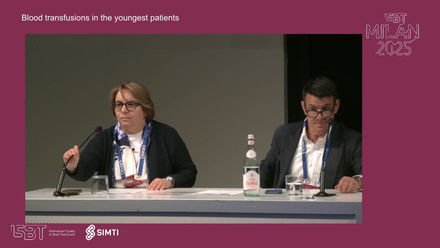
Paediatric Transfusion Resources
Members only


Members only

Members only


Members only
Members only


Umbilical Cord Blood Transfusion Working Group
Led by Satyam Arora (India) and Elise Huisman (The Netherlands), the Umbilical Cord Blood (UCB) Red Cell Transfusion Working Group operates under the Pediatric Transfusion Subgroup. This dedicated working group focuses on the scientific, clinical, logistical, and regulatory aspects of using umbilical cord blood–derived red cells for neonatal and pediatric transfusion.
Umbilical cord blood represents a unique and underutilized resource. Its potential role in neonatal transfusion—particularly in preterm infants—has generated growing international interest. However, clinical adoption requires standardized protocols, safety data, and global collaboration.
Activities/ Meetings
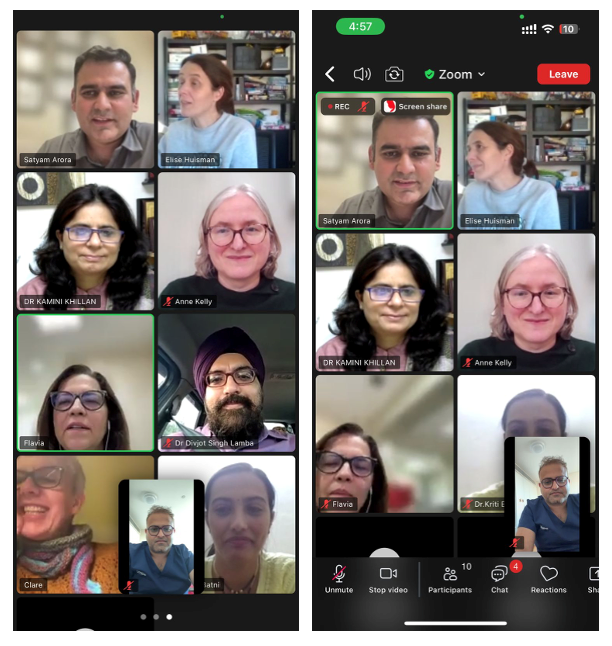
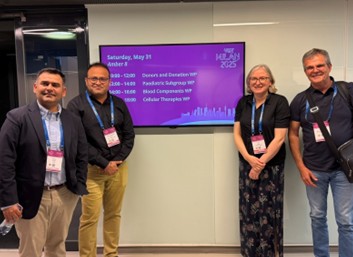
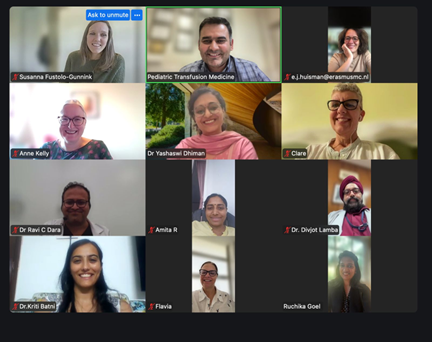
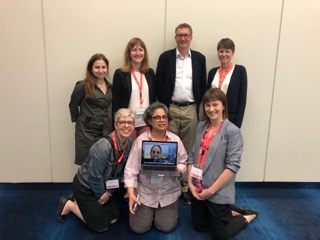
We meet at the ISBT congresses and hold regular teleconferences (2-3 times per year).
Who Can Join?
We welcome:
- Transfusion medicine specialists
- Pediatricians and neonatologists
- Hematologists and oncologists
- Intensivists
- Apheresis specialists
- Nurses and allied health professionals
- Researchers and data scientists
- Trainees with interest in pediatric transfusion
How to Get Involved
Members of the International Society of Blood Transfusion (ISBT) can join the Clinical Transfusion Working Party and participate in Pediatric Subgroup activities.